

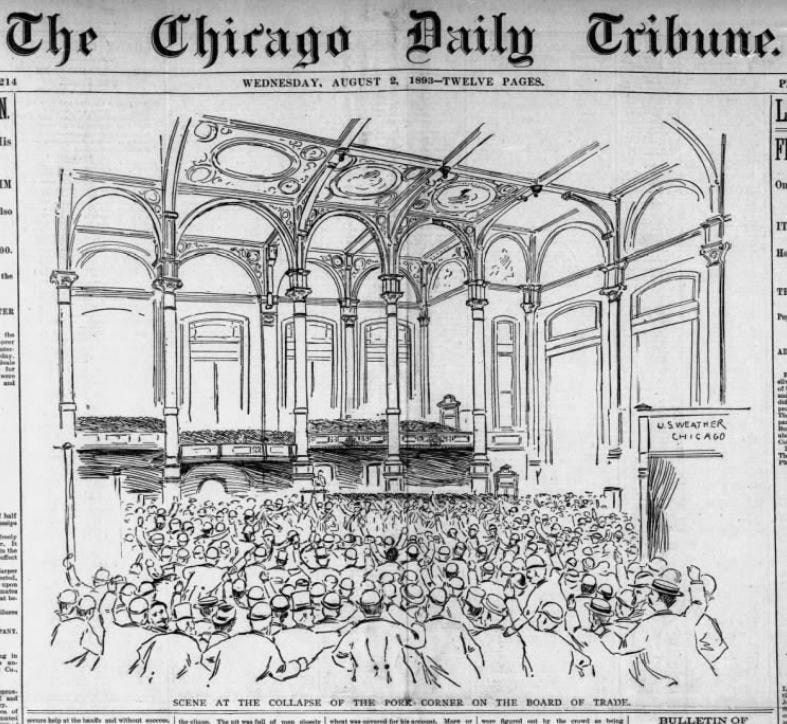
Chicago Daily Tribune, 1893
Every day is an infinite scroll feed—an endless churn of bot posts, betting lines, and the ambient casino of Discord channel notifications. Everyone is their own minor hedgefund, betting on everything from political races to the next celebrity scandal to the next world war. It’s tempting to view this wave of hyper-speculation as a product of the digital age, but the history of speculation actually trails back much further.
The first formal futures markets were born in Chicago in the late 1800s. They were radical, new contracts that let you buy and sell commodities such as wheat, pork, and corn without having the assets on-hand. You could profit (or lose everything) based simply on your hypotheses about the future, instead of being restricted to only what you could physically store in a warehouse. Anyone—from farmers to merchants, to urbanites—could make a wager on the price movement of these material goods. Bucket shops were the street betting parlors where the action took place. Within them, there was a sense of a kind of collective fever—rooms packed with people, reading old newspaper accounts, watching the ticker, rumors swirling, fortunes made and lost in an afternoon. Bucket shops were proto-prediction markets.
Politicians railed against the financiers and speculators who profited off of the volatility, but in the background they often adopted the tools themselves. Moralists and journalists debated what this could all mean for the future of society. Was this a new way for ordinary people to claw back a little agency in a rigged system? A new form of financial empowerment? Or was it simply just a more efficient method of separating people from their savings?
At the very least, it created as much collective anxiety as it did collective fantasy.
All of this feels like a prologue to our current moment. However today, instead of betting on bushels of wheats, we bet on abstractions and social signals. The commodity has dematerialized. The bucket shop is now a Telegram group, the wheat future is a memecoin. From Debord: “The spectacle is not a collection of images, but a social relation among people, mediated by images.” The old futures market was a spectacle in this sense. Today, it’s Discord servers and Twitter timelines.
We like to think that betting on dog coins or the outcome of a Supreme Court case is a product of the digital age, but it’s really just the latest round in a very old game. Speculation is how capitalism metabolizes uncertainty, how people try to make meaning (or at least a quick bag) out of the chaos. Speculation has always been an undercurrent of our inherently social world—the hope that if enough of us buy in, we can bend reality, or at least ride the wave for a while.
Speculative Communities: Living with Uncertainty in a Financialized World by Aris Komporozos-Athanasiou
The Society of the Spectacle by Guy Debord