

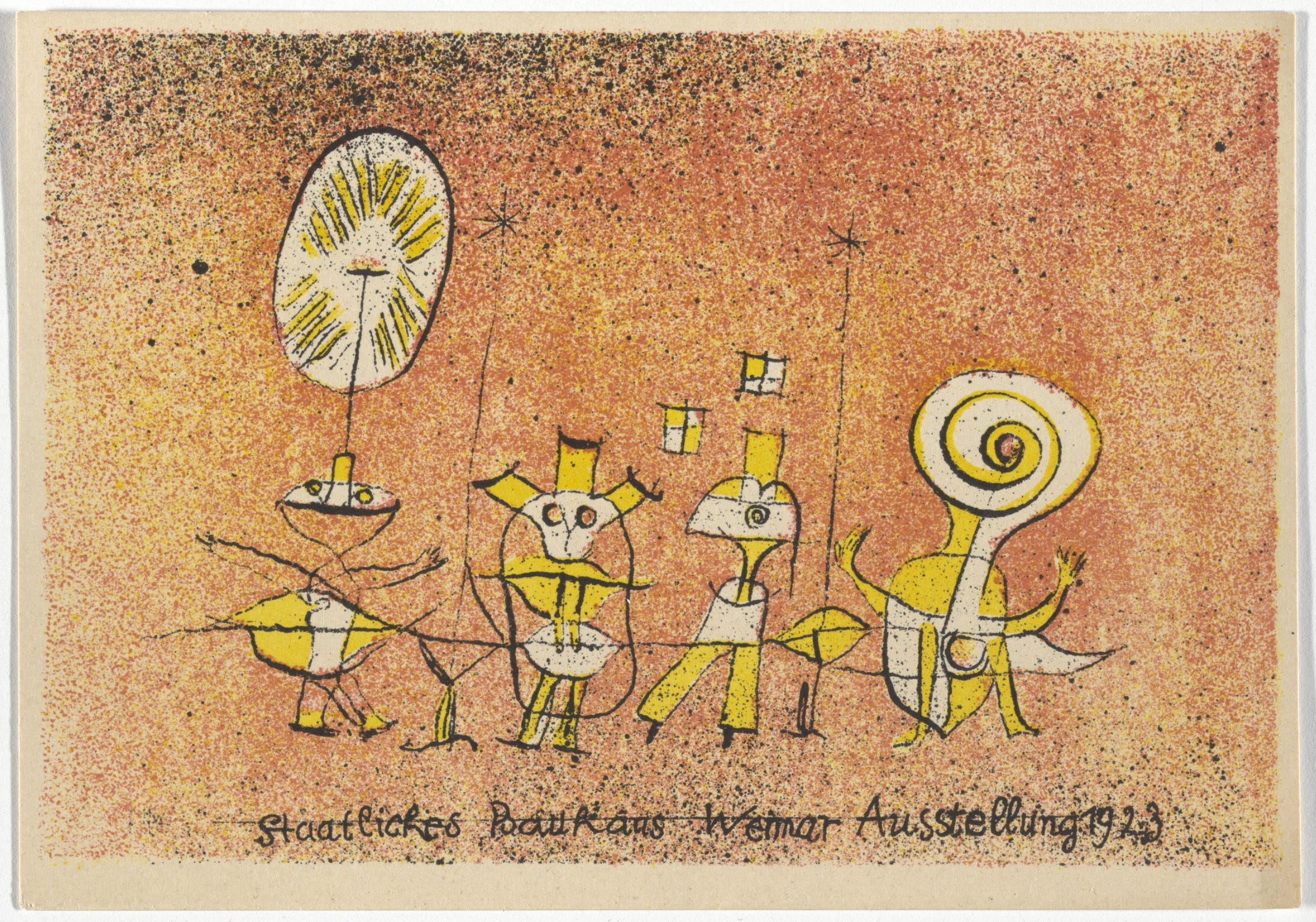
Paul Klee, Bauhaus Ausstellung Weimar 1923, 1923
In December 2025, Tyler Cowen and Patrick Collison published “A Call for New Aesthetics,” a call to action for “artists, architects, and designers who are consciously working to define New Aesthetics,” invoking Bauhaus as a movement that “[defined] an aesthetic for the twentieth century.”
In conversations I’ve had with artists, many, if not all, pointed to the internet as a major turning point for aesthetics, irrevocably changing how we think about art and culture at-large.
The question is not whether contemporary art still produces shared aesthetics. The more slippery question is whether it still produces formations durable enough to become historical objects (movements), rather than ephemeral alignments (trends).
Art history once relied on the assumption that such objects could form: that artists could cohere around shared ideas and eventually be sealed together within a linear historical trajectory. That assumption now feels unstable. People register this instability as cultural weightlessness. What Cowen and Collison seek is a coherence—something capable of organizing art, technology, and social ambition into more than a series of blips in time. Whether such coherence can still emerge under current, contemporary conditions is the question I’d like to explore.
In his book After Art, art historian David Joselit argues that networked culture (digital networks, globalization, etc.) fundamentally altered how cultural value accrues. Under earlier conditions, artworks gained value through historical positioning—their ability to sit within successive, legible narratives of development and stake claims on history.
Art movements were the primary mechanism for organizing cultural debate around what mattered, what counted as innovation, and what marked progress. Dada marked the collapse of faith in rational progress after World War I; Minimalism emerged in direct response to Abstract Expressionism; so on and so forth.
Within networked culture, however, value accrues through movement itself—visibility, reach, and speed. When circulation becomes the primary source of value, context loses its leverage. Images now gain power through their capacity to be remixed and recontextualized as they move between nodes in a network. While sustained discourse was previously essential to establishing an artistic movement, rapid convergence becomes the key to reducing friction and accelerating transmission.
Bauhaus is an interesting historical case study. Founded in 1919, Bauhaus emerged from a shared artistic question: How should art respond to industrialization? Bauhaus artists rejected past notions of academic pedagogy and romantic individualism, and instead experimented with simplified, modular design, and mass production. Its recognizable style emerged from a sustained process of debate between its artists: How should form relate to function? What social purpose should design serve? This coherence depended on institutional structure—shared training, sustained collaboration, and relative insulation from immediate commercial pressure.
Walter Benjamin’s analysis “The Work of Art in the Age of Mechanical Reproduction” helps to explain the erosion of the conditions that enabled Bauhaus as a movement. Writing in the 1930s, he argued that mechanical reproduction reorganized cultural authority by detaching images from their context. Consider a religious painting viewed in a church. Its cultural authority and meaning derive not only from the work itself, but also from its lineage and tradition within the church. A photograph of the same painting could now circulate freely, detached from the church. Viewers no longer approached the work as something embedded in a historical lineage, but as an image available for repeated, decontextualized consumption. Cultural experience shifted accordingly.
In the mid-twentieth century, this shift remained compatible with the formation of art movements because mass media distribution was still centralized. Institutions like film studios, publishers, and museums functioned as chokepoints that controlled and slowed circulation.
By the 2000s, internet speed saturated culture and circulation became instantaneous. Under these conditions, coherence no longer needed to pass through sustained discourse to become legible. Historical positioning gives way to movement as the dominant source of value.
Hito Steyerl takes this analysis further. In “In Defense of the Poor Image,” Steyerl describes that images that move online are structurally designed to degrade as they circulate—compressed, resized, stripped of metadata, and detached from any fixed source. This condition has implications for how art movements may attempt to form. Debate requires objects stable enough to be discussed over time, but “poor images” resist this stabilization by design. Their aesthetic properties become inseparable from the velocity of their circulation. Steyerl treats this condition neither as a loss to be reversed nor a gain to be celebrated, but as the material reality through which contemporary images now circulate.
In late aughts/early 2010s, Post-internet art emerged as an art movement that adapted digital-native conditions. Rather than a particular style, post-internet artists organized around the question of how to make art once the internet had become infrastructure rather than a novelty, encountering one another across internet forums and platforms like Tumblr instead of a structured space or market.
The internet not only became a new vehicle for distribution and legibility, but also enabled entirely new forms of artistic collaboration and aesthetic experimentation. Artists worked in public, interdisciplinary practices in digital, collective iteration with other artists. These formations rarely stabilize into movements, but they share a common set of technical conditions (platforms, networks, speed) that redefines and reorganizes how art is created and encountered. A quote from artist Parker Ito comes to mind: “Post-internet was the last true movement in that it was a group of people who organically came together with a shared belief system and semi-shared goals. All the movements since then have been market-driven.”
Zombie Formalism was another phenomenon that took shape parallel to post-internet art, but with opposite logic. Where post-internet art emerged as an design space spread across different underground venues online, Zombie Formalism formed immediately within legible market dynamics. Often described as a movement, it is perhaps better understood as an aesthetic convergence; large-scale abstract paintings that were gestural, muted, industrial in finish. Zombie Formalist works photographed cleanly and were compatible with compressed digital displays that gained additional online circulation. The rise of Instagram further amplified these tendencies. Visibility reinforced demand; demand reinforced visibility. Value accrued through circulation rather than through the slow consolidation of meaning.
At the institutional level, key figures openly embraced and applied internet-driven market logic to contemporary art early on. Jeffrey Deitch was both an effective and controversial figure precisely because he treated internet visibility as a viable and important form of artistic legitimacy. Many viewed Deitch’s practices as bringing wider audiences and making fine art more accessible. Those within fine art institutions saw the adoption of market momentum not as a natural evolution, but as a short-sighted substitution of more pure, intentional forms of curation.
There is a broader tension at stake within the discussion of art and aesthetics: strategies that successfully synchronize art and markets can generate immediate coherence, but often struggle to sustain the depth and internal differentiation required for movements to endure.
“A Call for New Aesthetics” risks misidentifying the problem. The issue may not be the absence of sufficiently ambitious aesthetic programs, but a disconnect between the “movement” Cowen and Collison search for and the infrastructural realities that govern cultural production today. If something like a new Bauhaus is imaginable, it will depend on structures that slow circulation enough for disagreement to matter. The harder task is to confront what would have to change—about markets, platforms, and cultural history itself—for coherence to endure.
IN CONVERSATION WITH: Parker Ito