

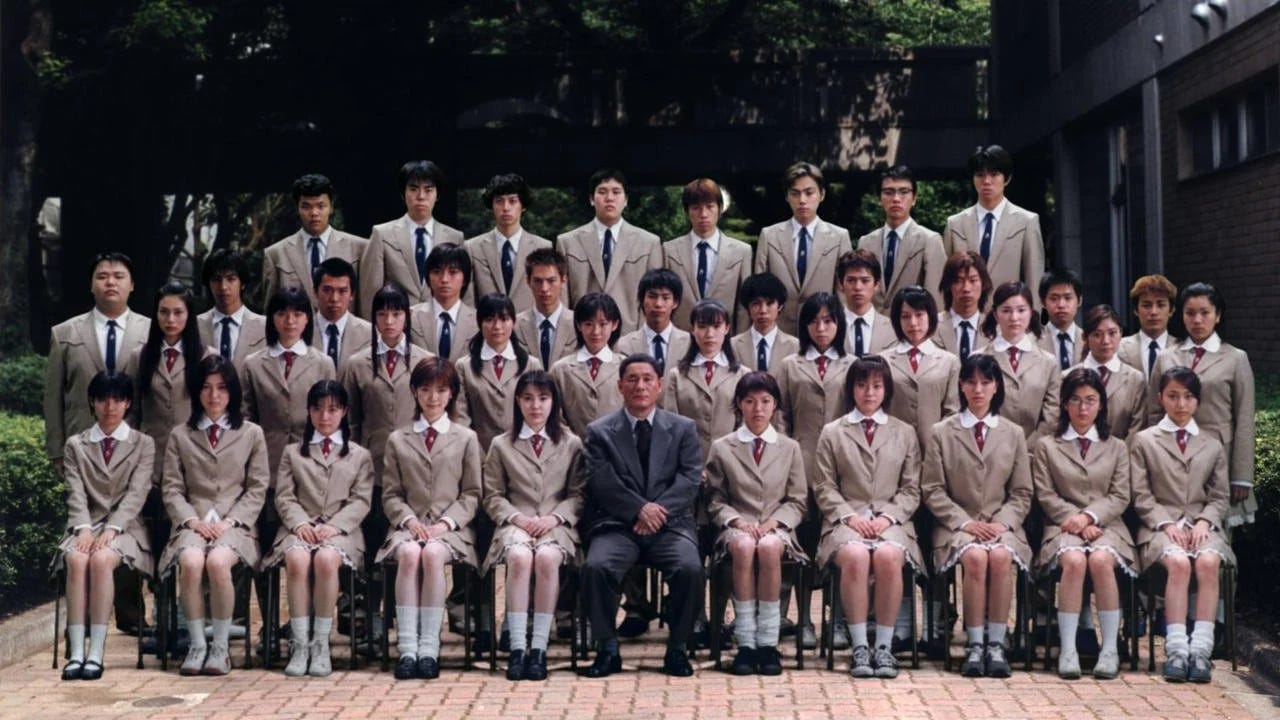
Battle Royale (2000)
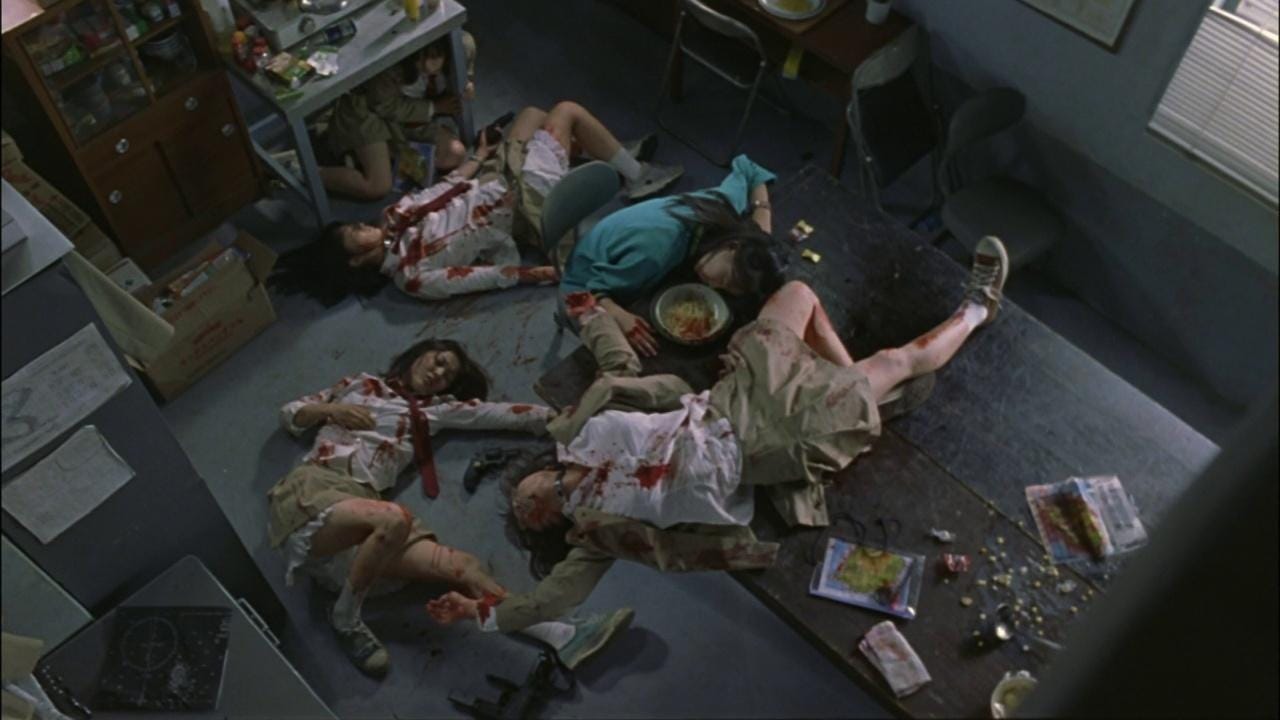
A class of ninth graders is gassed while on the bus for a field trip. They wake up on an island with exploding metal collars and a bag of random weapons, and are told they have three days to kill each other until only one student is left standing.
Battle Royale (2000) birthed a new genre of games and media: PUBG, Fortnite, and Apex all emerged within its lineage.
The film takes place under an authoritarian Japanese government that has lost confidence in its youth. As a way to curb juvenile delinquency, it passes the Battle Royale Act, a government-mandated annual event that ships a randomly chosen class of children to an island to kill each other. Presiding over the event is Kitano, a former teacher who was once stabbed by one of his students and cast off by his own family. He has decided that he has nothing left to live for, and the state has handed him a system that lets him act on it.
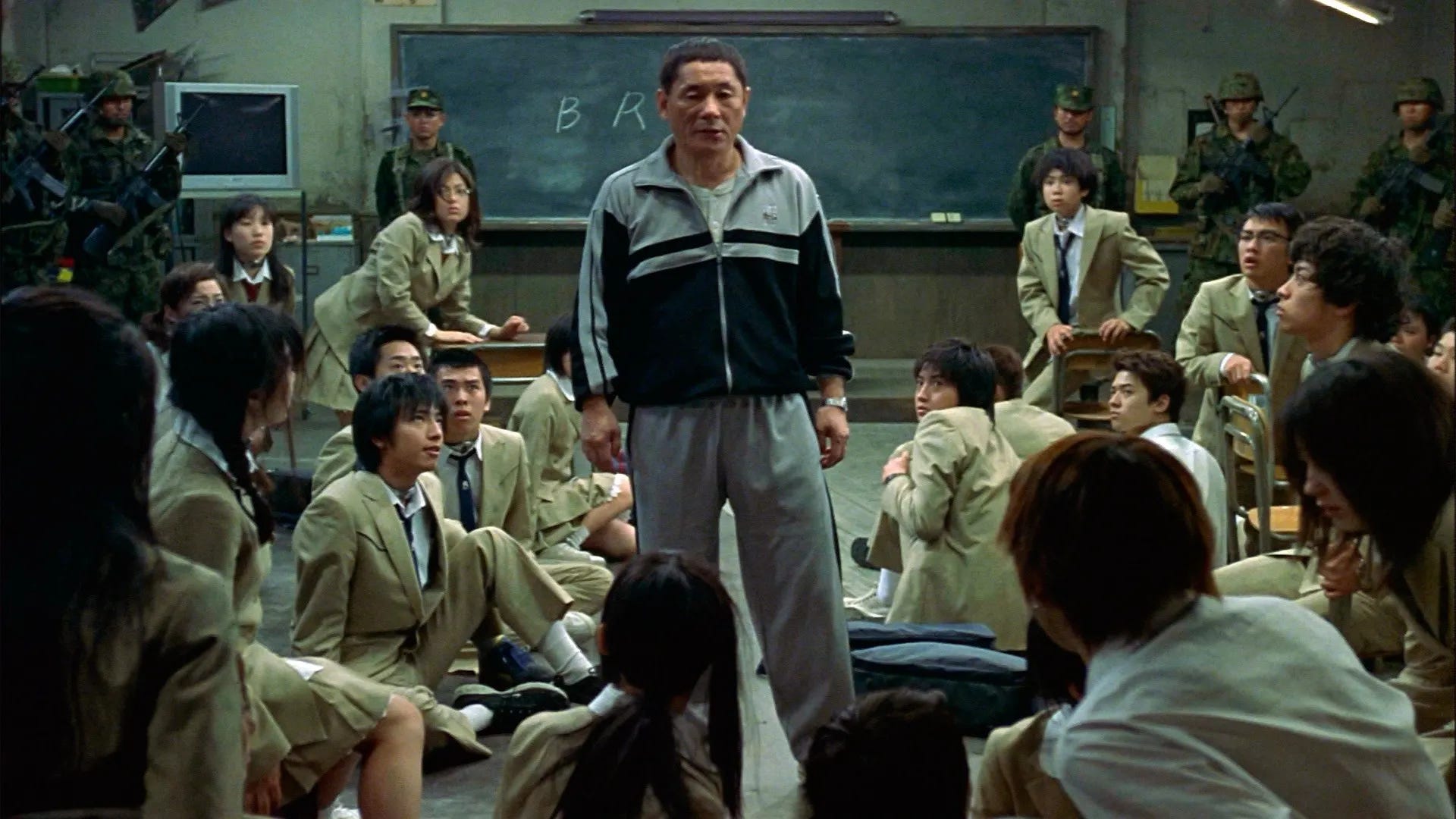
The mechanics of the Battle Royale Act describe a practically perfect multiplayer game: drop a large group into a confined space, give them weapons, and let the last one standing win. The genre it spawned has become one of the most profitable genres in gaming, now worth over $10B. What these modern games keep is the battle royale system, but they drop what makes the film so unbearable, and therefore meaningful. Nobody is gassed onto the island in Fortnite. The strangers who land there don’t owe each other anything. Battle Royale is the reverse on both counts. The opponents you kill are your own classmates, and the person who sends you to kill them was supposed to be your mentor and guardian.
In 2000, this premise was less of an exaggeration. In the 1990s, Japan lost confidence in its future and its children, an era now called the “Lost Decade.” In 1989, a man was arrested for the murder of four young girls and a vast collection of anime videotapes (amongst other media) was found in his apartment; the press named him the Otaku Murderer and built a panic around the idea that the media/culture had turned the youth into predators. In 1997, a 14 year old killed a younger child and the fear moved from blaming the culture to blaming the children themselves. Battle Royale entered this current; the year the film was released, Japan lowered the age of criminal punishment from 16 to 14.


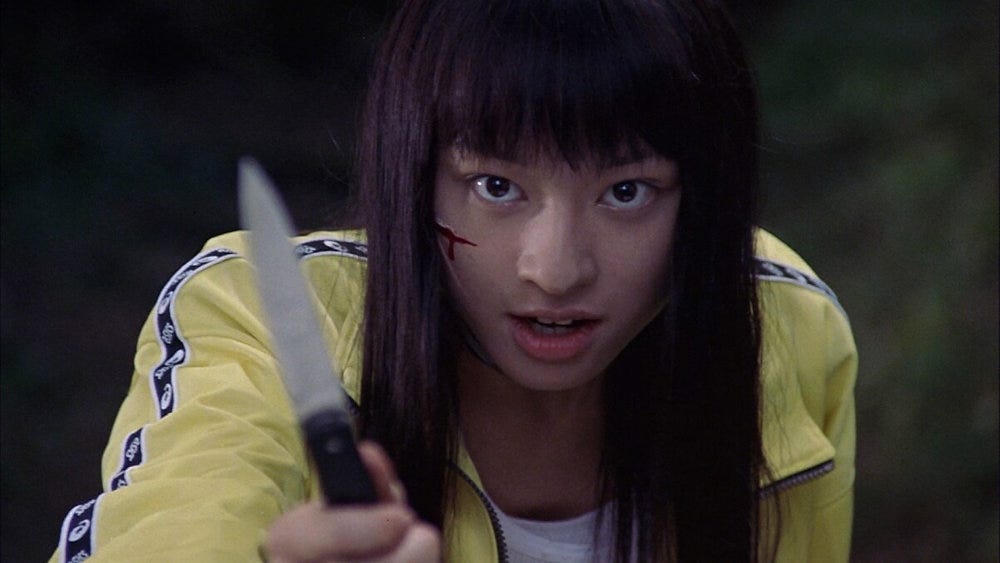
The battle royale genre has been the subject of much analysis over the last 20+ years, particularly as a criticism of late-stage capitalism. The premise of the genre rests on the conditions of scarcity and competition—a closed island, a fixed ration of supplies issued at random, a single survivor. It’s a world where the economy has already collapsed and unemployment has climbed so high that most students have quit school, and the state’s response is to make explicit that there is a fixed amount of everything and exactly one seat at the end.
In his post “Survival of the Purest,” Patrick Carland treats the island as a working model of neoliberalism. The Battle Royale Act is how a system responds when it can no longer take care of everyone; and the justification it gives is that adulthood itself is a brutal exercise in Social Darwinism, where only the strongest and most cunning are worthy of survival. This is Mark Fisher’s capitalist realism almost exactly, the condition in which it is easier to imagine the end of the world than the end of the system. In 2026, this condition has been dubbed the “permanent underclass,” describing a class the economy ruthlessly leaves behind. It is usually attached to fears about automation, though what it names runs deeper than a single technology or single blame.
Deeper than the economic reading of Battle Royale is a relational one, which begins from the fact that the man carrying out the Battle Royale Act is a school teacher. A school is the institution a society uses to hand itself down, where one generation equips the next to take its turn. In The Disappearance of Childhood, Neil Postman argues that school helps hold childhood open; it keeps a boundary between children and the full force of the adult world, introducing that world slowly, in stages. Battle Royale tears that boundary down and flips the institution on its head. The classroom still remains the rite of passage, but is now an initiation defined by murder. The state builds a mechanism to systematically dispose of its youth, while the teacher simply gives up on them.
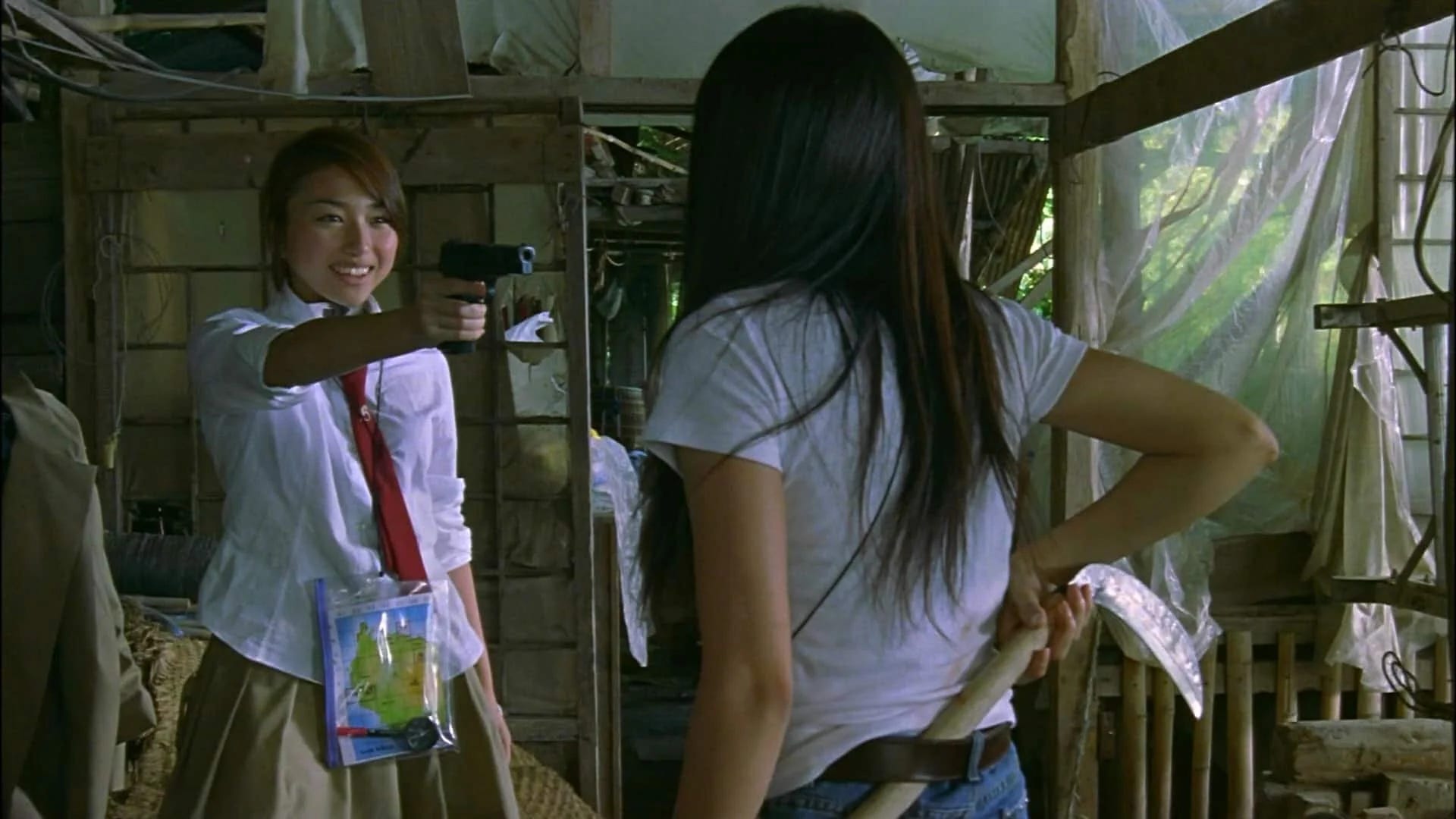
Across the institutions built to teach the young and carry down its practices, there is a throughline of generational abdication. Schools closed in 2020 and reopened forever changed—a cohort moved forward on schedule like nothing ever happened. The jobs students trained and credentialed themselves for are disappearing. Entry-level work, the rung of the ladder where every trade has always taught itself to the next set of stewards, is the first one automation is primed to remove. Civic life was supposed to model working order. Instead, a generation came of age during a time where the institution of government has not visibly worked within their lifetime, where neither party has delivered what it promised, and in-fighting and gridlock is the steady state. There is a shared sense among the younger generation that the machine is broken, and what they’ve inherited is institutional wreckage.
Each example of failed institution is Kitano’s gesture at scale. What gets called inevitable human nature is actually systems an older generation built and have stopped tending to. Battle Royale is best known for the genre it spawned, but the film’s true genius is what it understood about the society that made it. The economic reading sees a market and stops where Fisher does, at the conviction that the system cannot be replaced. But the film goes one turn deeper, to the institution a society uses to hand itself down, turned against the generation it exists to carry forward.
Love this movie and this analysis! Thank you!