

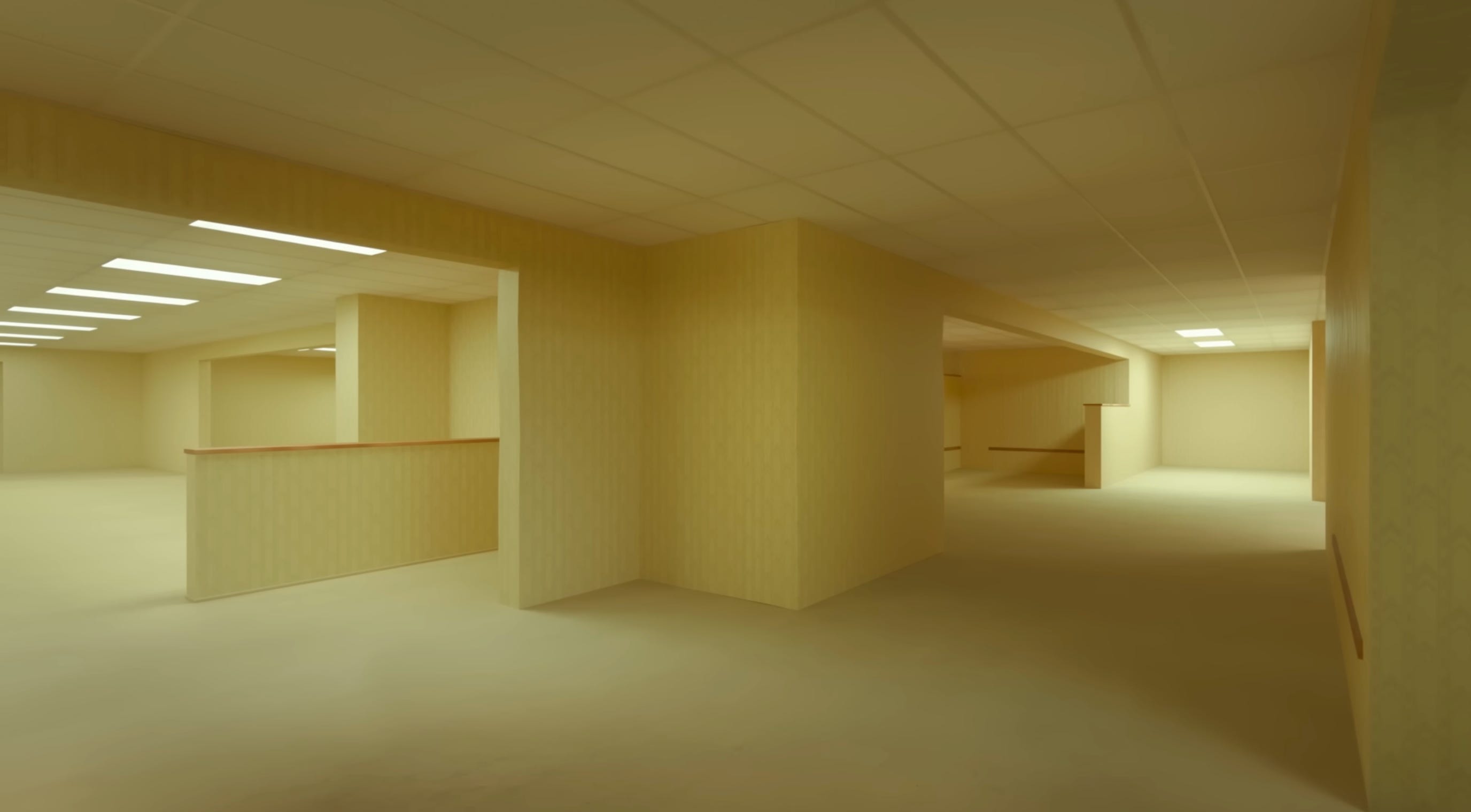
Backrooms (2026)
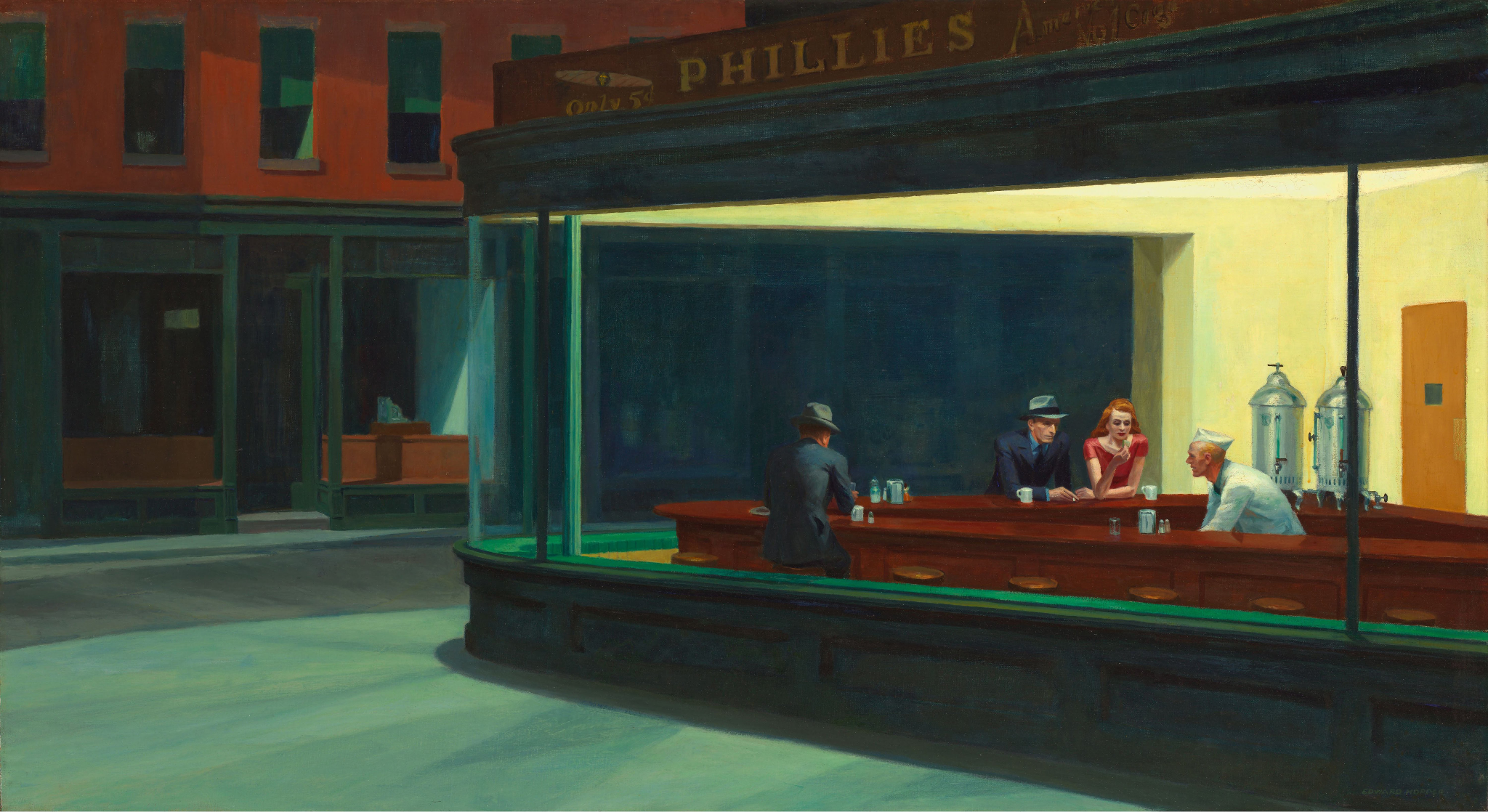
In Nighthawks (1942), Edward Hopper painted a diner in the dead of night—fluorescent light, a single customer and a couple sitting in silence, a dark, empty city outside the windows. Midcentury American painters often explored emptiness and absence as conditions of postwar life, and Hopper rendered it most precisely as liminal spaces: a room now empty of people, but still warm with the memory of their presence.
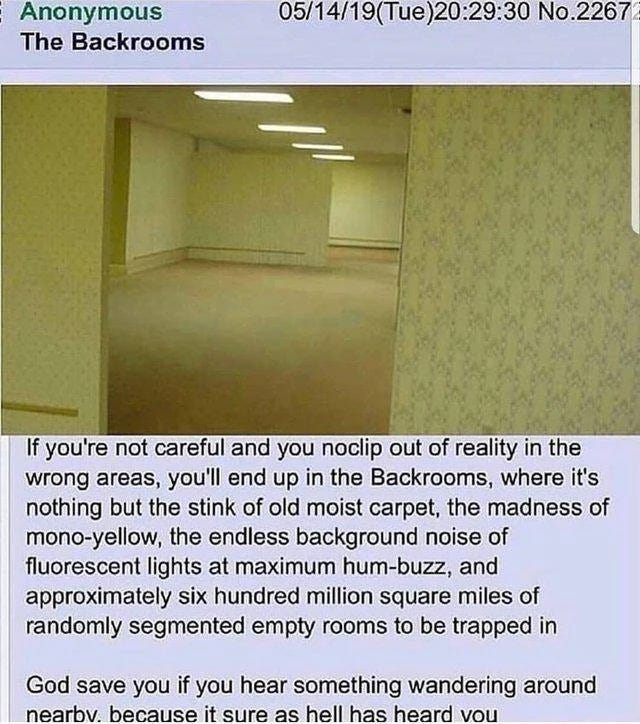
The internet began to claim its own version of liminality in 2019, on a 4chan board used to post and describe images that just “feel off”: an empty mall, a hotel hallway with the lights still on. One day, a user posts a photo of an empty fluorescent yellow office space, and the next day someone gives the photo a backstory and names it “the Backrooms”. Within months the Backrooms has its own subreddit, its own wiki page, and hundreds of contributors writing accounts of being trapped inside.
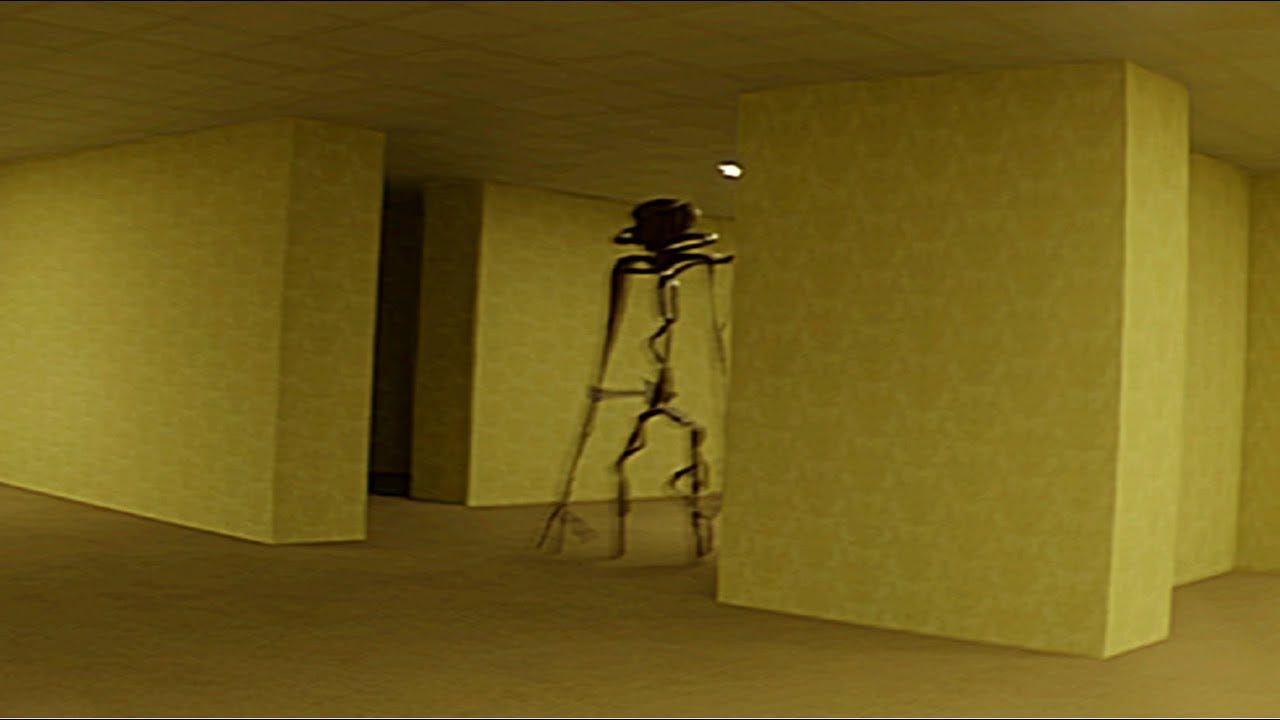
In 2022, Kane Parsons (16M) uploaded a video to YouTube called “The Backrooms (Found Footage)”. Teaching himself Blender and After Effects, Parsons rendered the original image in 3D and framed it as VHS-era found footage of a person navigating the Backrooms and its curiosities. The video hit 20M+ views, and Parsons turned the original into a series, which A24 then optioned for a feature. The film opened to $81M domestic and $118M worldwide—the biggest opening in A24’s history. 85% of the audience was under 35, and more than 50% under 25.
The original Backrooms phenomenon established liminal as a sort of hyperreal, internet-native aesthetic: low-res POV photos of unsettling spaces. In “In Defense of the Poor Image”, Hito Steyerl theorized that the dominant image of the 21st century would be exactly this: the sourceless, heavily compressed JPEG, reposted enough times that its degradation becomes part of its meaning. The Backrooms image is poor in exactly this sense. Its power comes from arriving both sourceless and from everywhere at once. When users try to trace the image’s origin, the investigation becomes part of the artifact, the circulation of the image constitutive of its meaning. It took several years and hundreds of online collaborators to pin the original image to a hobby shop in Oshkosh, Wisconsin.
The internet, itself, is a liminal space. It is the place you go through on the way to somewhere else, except the somewhere else has no end. Digital platform design since the early 2010s—infinite scroll, autoplay, algorithmic feeds—has been built to extend the liminal phase. The feed has no destination.
Video games, in particular, have been a massive influence on the spatial and aesthetic sensibilities of the online generation. While first-person video games are older than the internet, dating all the way back to Maze in the 1970s, the first-person camera became a dominant way of seeing for an entire generation that came of age on the internet.
In Gaming: Essays on Algorithmic Culture, Alexander Galloway traces the first-person subjective shot through cinema. Film historically used the first-person almost always to signify an alternate way of seeing, an eye that was not quite human—the famous Hitchcock subjective shot, drugged and dreaming.
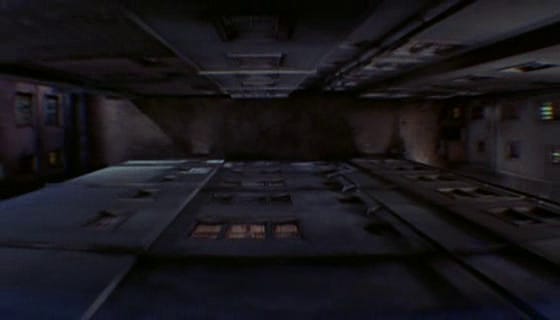
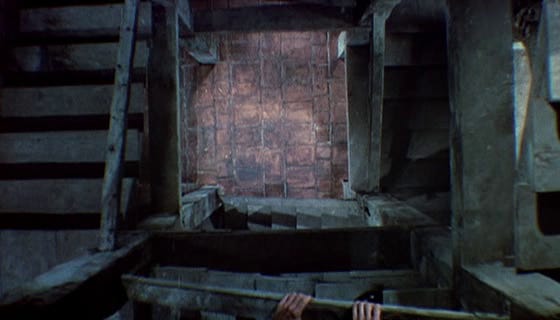
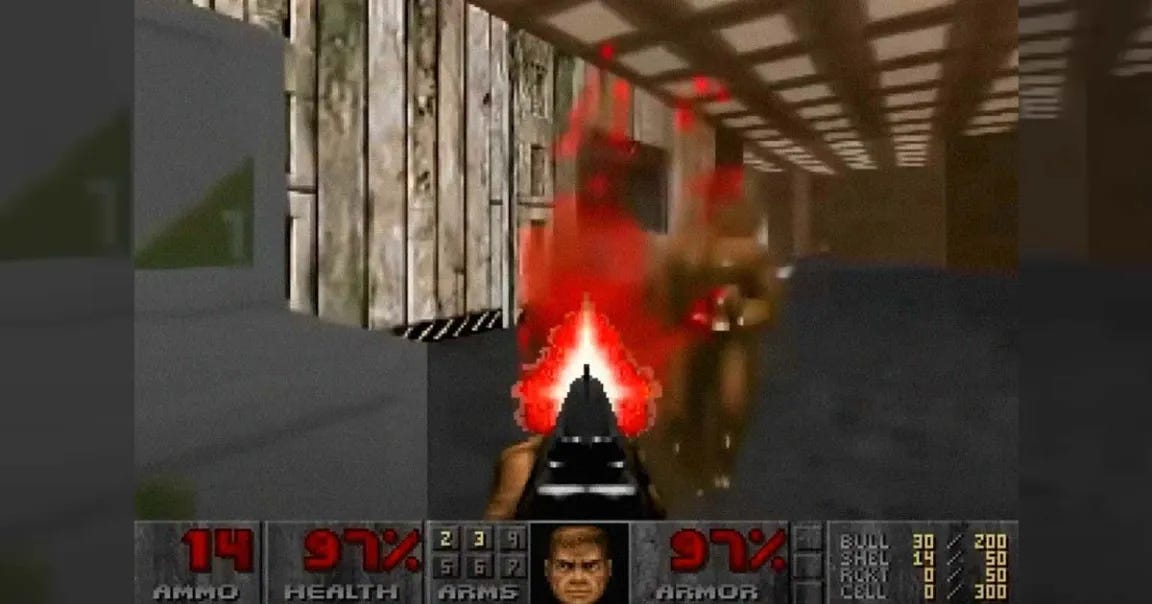
In video games, the subjective perspective is common and often used to achieve an intuitive sense of motion and action in gameplay. Games like Doom or Half-life or even Minecraft or Roblox all took the alienating cinematic shot and made it the standard way you traveled through space.
The liminal condition extends beyond aesthetic. The term liminal was originally coined in 1909 to describe the rite of passage. And more specifically, the awkward middle stage where a person is no longer who they were, but not quite yet who they will become—Odysseus on Calypso’s island, Frodo in Rivendell.
The traditional rite of passage moves a person across a threshold and into a community that recognizes them as transformed. While the contemporary rite has kept the threshold of the wedding or the graduation, it has lost the community that would have borne witness to the change. The result is a generation fluent in thresholds, but less convinced that thresholds actually lead anywhere or hold meaning. Posting an image of an empty hotel hallway becomes a way of saying aloud something that otherwise stays ambient.
This is why, in a Hopper painting, the empty diner registers the absence of people, but in an internet image, the dead mall doesn’t appear empty; it is the spatial form of an ambient condition the viewer already inhabits. The eye has been trained to expect continuation rather than arrival.
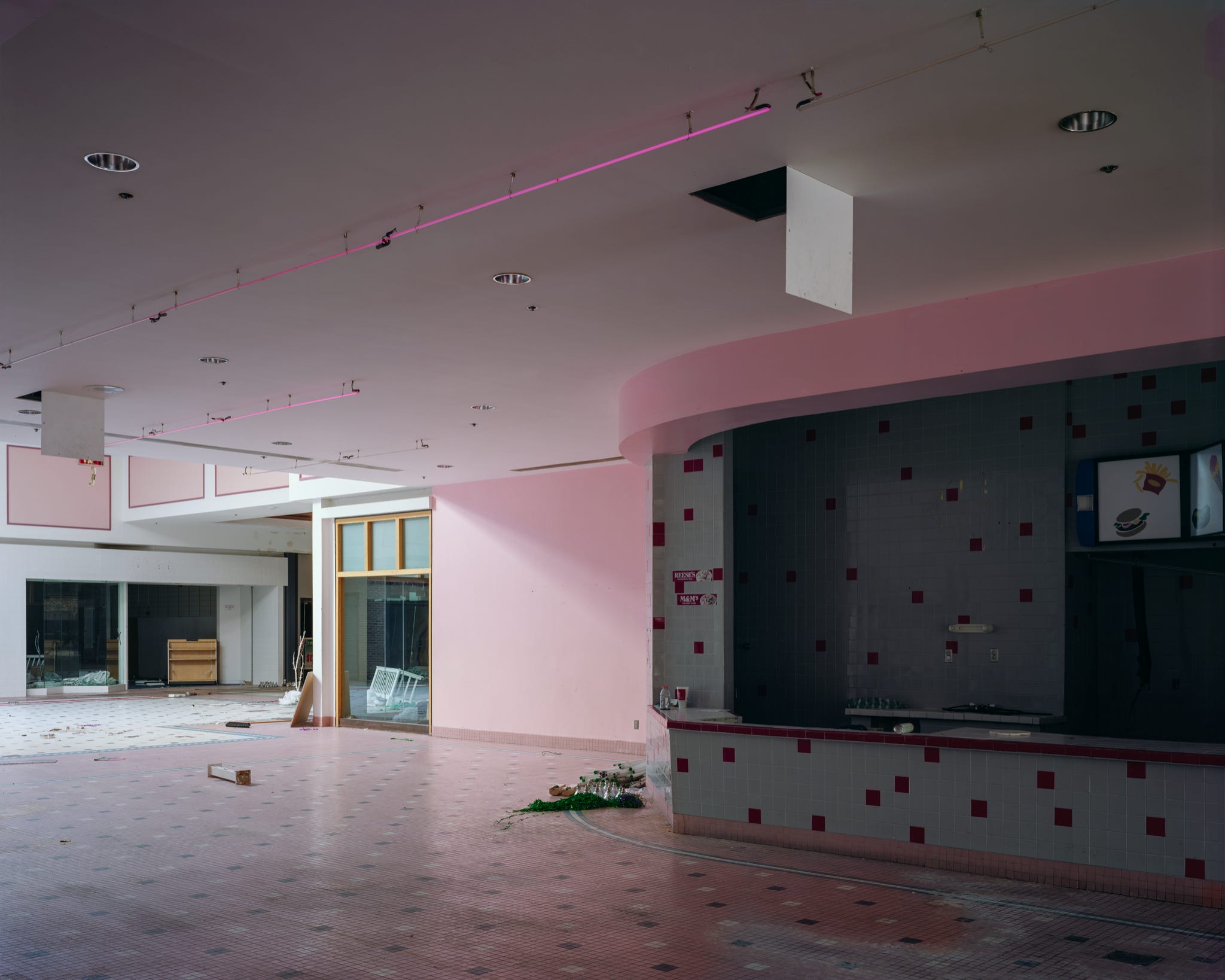
All these dynamics come together in Backrooms the film: an endless liminal space, rendered in the subjective perspective of a first-person video game, drawn from an image that traveled the internet for years.
The formal grammar of slow cinema is not new, but Backrooms, both in its production and its deployment is a groundbreaking artifact of an emerging generation native to liminality.
An older filmmaker could’ve understood the Backrooms intellectually, shot it beautifully, and probably would’ve more successfully drawn the Backrooms lore into a conventional film with plot, theme, and character development. But they still would have had to translate it into cinema from the outside.
Though fair critiques of the film, they miss what makes Backrooms interesting and why it matters. It is unmistakably the work of an internet-native filmmaker, made for an internet-native audience. Parsons’s influences, in his own words, are a product of the condition of growing up online rather than through formal training. The first-person camera moves with the player-eye drift that any player would recognize. The pacing refuses to populate space. He understood that the emptiness was the point. The film does not explain what the audience is supposed to feel because it sits in a register that they already inhabit. Backrooms is the first breakout theatrical hit to translate the internet’s liminality at this scale.
The film’s performance is evidence of an emergence more interesting than a one-off box office success. An online, distributed generation has developed a coherent aesthetic category for the embodied structure of contemporary, online life, and Backrooms offers a rare occasion for it to share physical, communal presence around a film that recognizes it. An audience coming of age has shown up to see themselves rendered.
Thank you to Eugene for feedback and always invaluable insights on film
love how you connect the liminal space of the backrooms to that of the internet; our online experience only captures fragments of larger ideas and larger works, much like the "memory" of the backrooms. to see their functions rendered so perversely is disturbing.
I think the film doesn't matter. Once it leaves the Internet, it no longer functions.