Raise the Red Lantern (1991)
One of the first things you notice while watching Raise the Red Lantern (1991) is its composition.
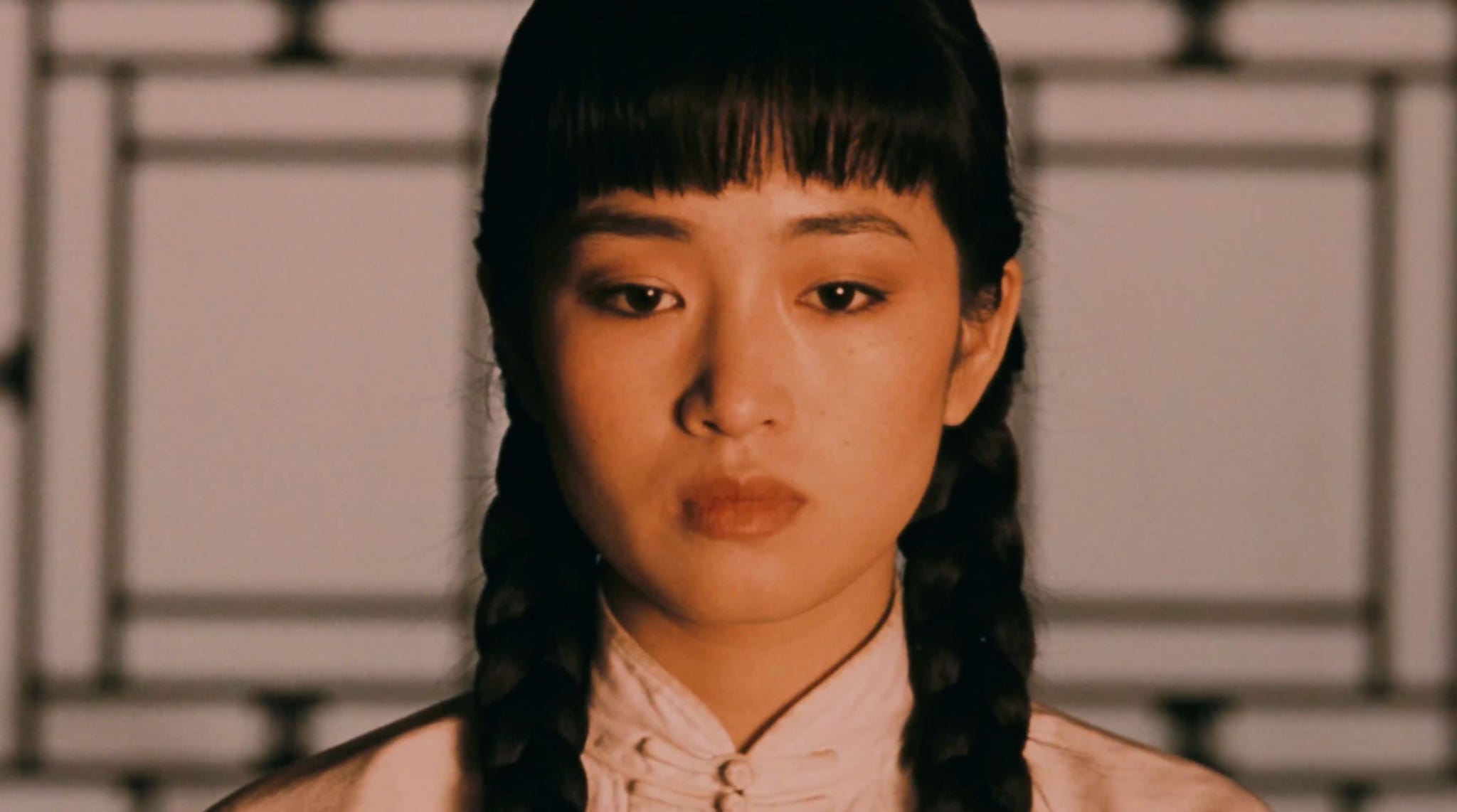
The opening scene is an extreme close-up of the film’s protagonist Songlian telling her stepmother that she has decided to marry a wealthy man, to whom she will become the fourth and youngest wife. In the background, a symmetrical geometric screen accentuates the symmetry of her own face.
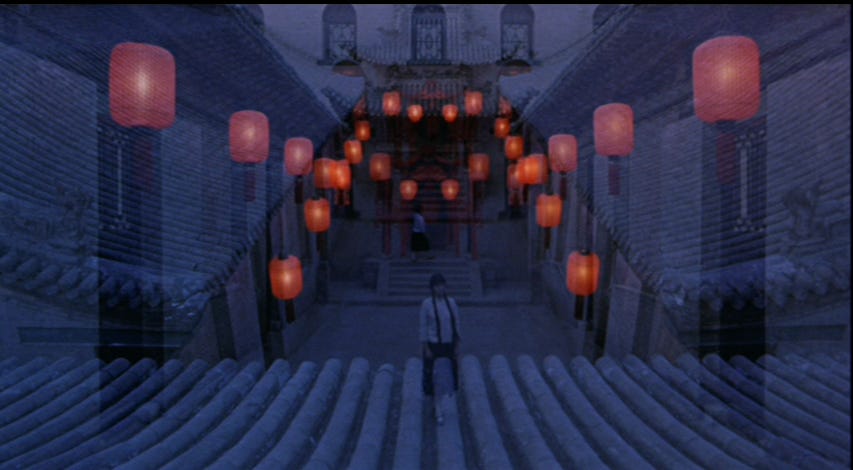
We then follow her to her new husband’s home, a Chinese courtyard house that is really more like a massive, enclosed compound. There’s symmetry everywhere—the entrance to each of the four wives’ individual houses is marked by a grand door framed by enormous red lanterns on either side. Zhang's use of symmetry is especially impressive given that the film was shot at an actual historic family home. Symmetry is easy to manufacture when you can create, move, and remove your own walls, but Zhang masterfully maneuvers and highlights the historic site.
Symmetry in film typically evokes harmony, but in the case of Raise the Red Lantern, its repetition creates a claustrophobic sense of rigidity. The courtyard’s passageways are framed by doors within doors creating the illusion of a neverending labyrinth of mirrors. It also suggests that each wife is interchangeable, confined to their own identical quarters for the master to come and go, travel back and forth, as he pleases.
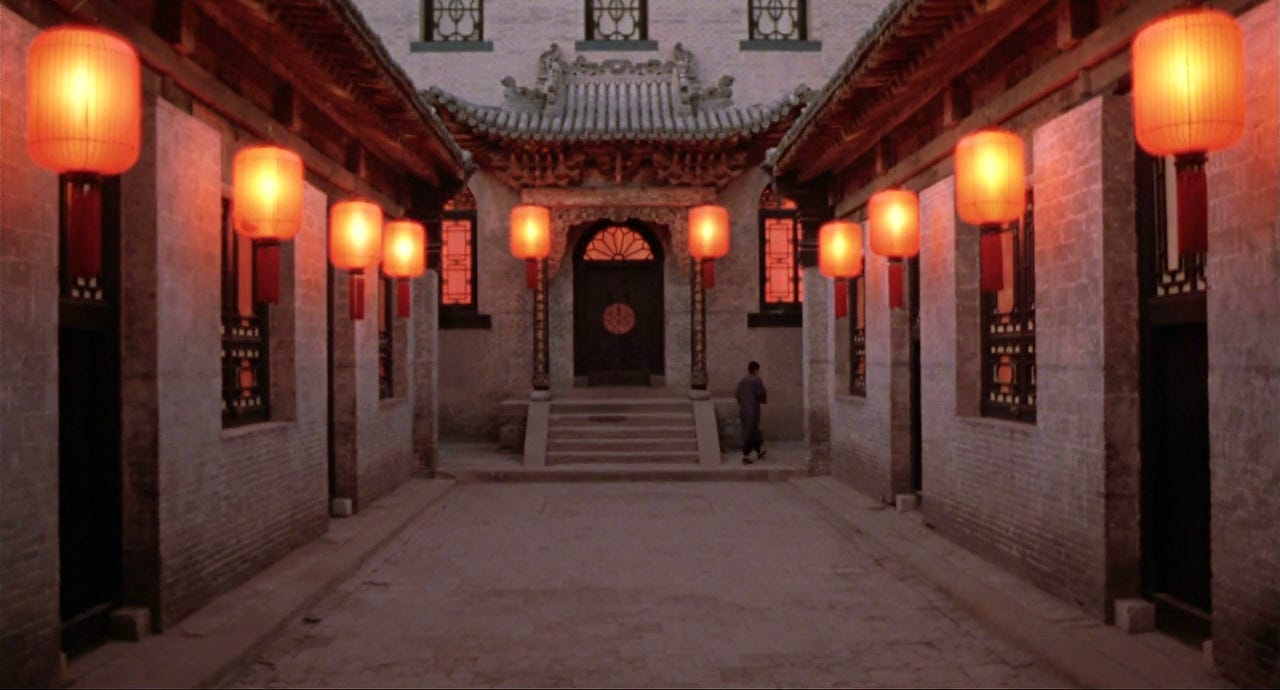
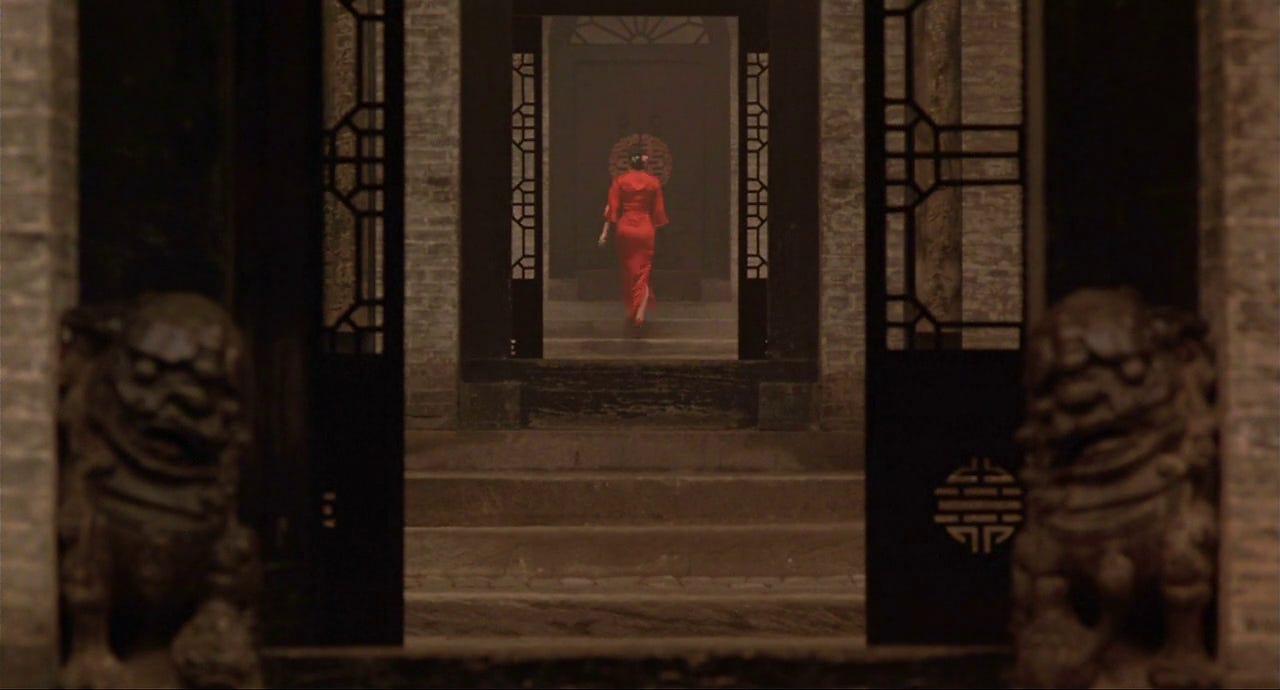
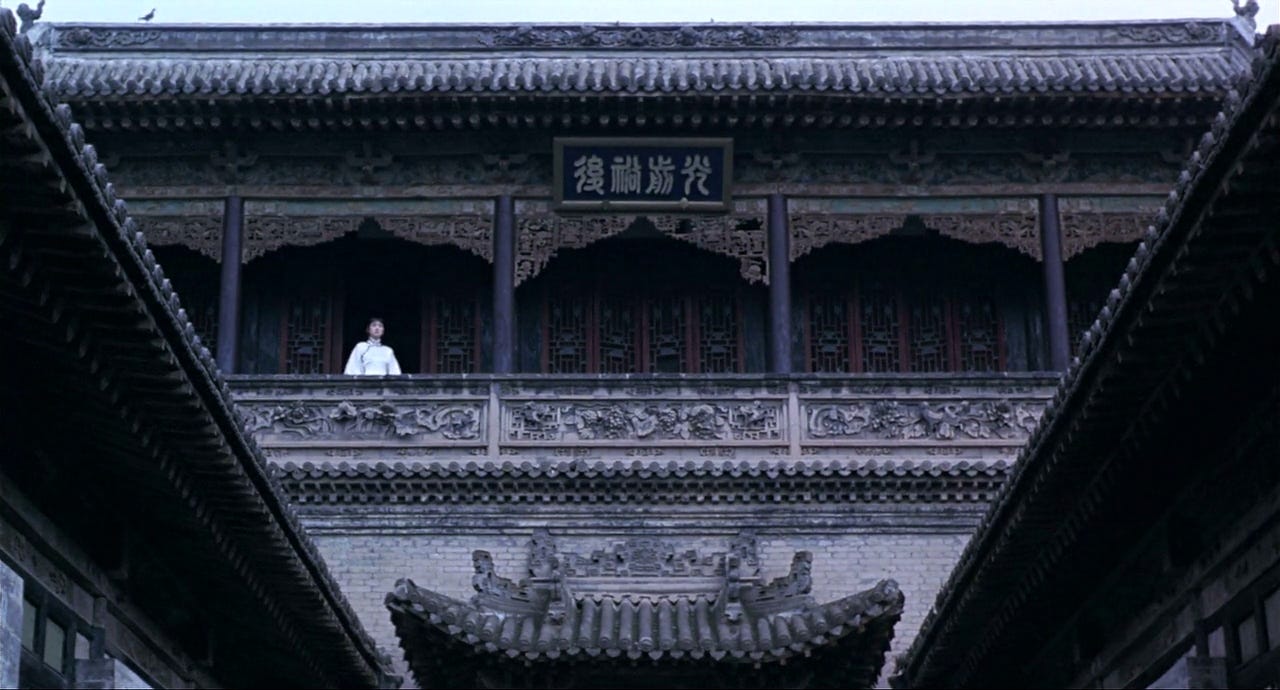
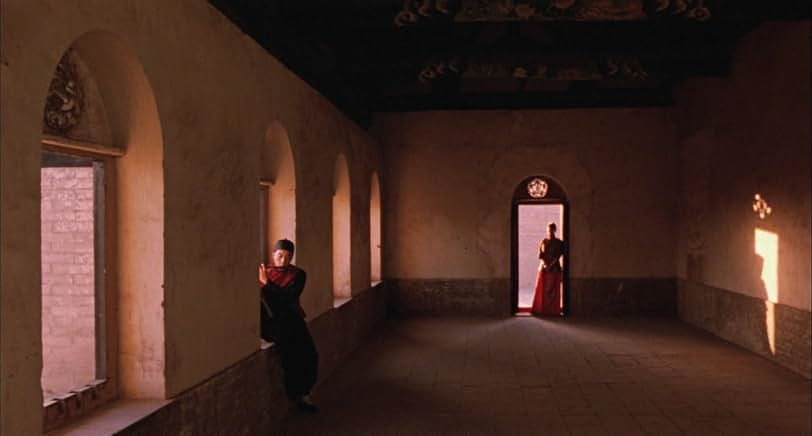
While the ground is characterized by stark uniformity, we may also take to the air. Zhang accentuates the vastness of the compound by featuring its open-air architecture. The wives often hold conversations with each other outside across multiple vertical levels of the courtyard—yelling in the distance straining to be heard or looking down upon the other with authority.
The courtyards are open to the sky, but they’re also open to observation, becoming a means of surveillance. The film rarely relies on conventional images of imprisonment. The women can walk through the courtyards as they please—free to move, but not to leave. Zhang’s wide, static compositions make the women look small, almost incidental, to the architecture around them. Even the tiniest interruption to the frame—a look, a pause, or a simple walk back to the house—feels laden with meaning.
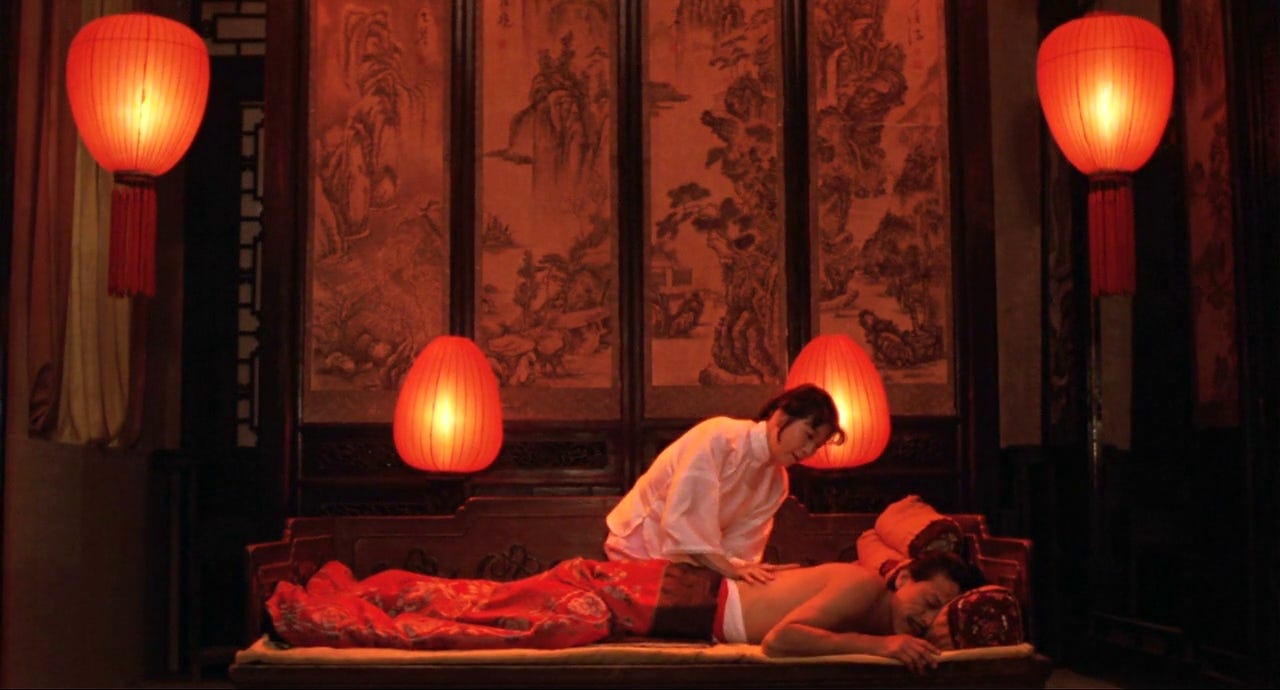
Perhaps the film’s most interesting narrative decision is how little we actually see of the wives’ husband and the proprietor of the house, Master Chen. In every scene with Chen, he speaks out of the corner of the frame or we only see his backside. One of the only lines that provides direct insight into his character takes place on Songlian’s wedding night. As she and Chen undress to go to bed together for the first time, she tells him to blow out the lanterns. He replies, “I have all these lanterns so I can look well. I like it bright and formal.”
What we do learn about Chen comes largely through his invocation of the household’s rituals and traditions. Central to the film is the tradition of the red lanterns. Every day, the wives gather outside their homes waiting for “instructions from the Master.” Chen chooses which wife he will spend the night with by placing a lit red lantern in front of the passageway to her house, after which the other wives can retire for the day. The lanterns surrounding the chosen wife’s home are then lit for the rest of the night, while the others remain blown out—ghost-like puffs of smoke in the night.
While Songlian initially feigns indifference to these rules, she quickly learns that she will not be able to sustain that attitude for long. The wife with lit lanterns earns privileges—a foot massage at the end of the day, better treatment from servants, the authority to choose the menu for the next day’s shared meals. These are remarkably ordinary choices, but within the compound, the freedom to exercise preference becomes something the wives must compete for. Songlian eventually exploits these rules herself, faking a pregnancy to secure special privileges, as a pregnant wife has lit lanterns for the duration of her entire pregnancy, and wives who bear sons are clearly favored. Her attempts to gain some measure of control increasingly depend on participating in the same system she initially regards with indifference.
These ancestral customs create the prison within which the wives relate to themselves, Chen, and to each other, allowing Chen to remain physically absent from much of the conflict he creates.
The film then focuses on the interpersonal dynamics of the four wives, competing for control of the house and ultimately the freedom of voice. Chen barely needs to appear because the entire household functions as an extension of his authority. The wives and servants administer his rules, monitor one another, and enforce punishments—all in the spirit of family tradition.
We learn about each wife’s personality primarily through how she navigates the rules of the household, and the ways she deceives the others to gain control. Meishan, a former opera singer, is the third wife and closest in age to Songlian. Initially the film’s obvious antagonist, she is prone to theatrics and openly hostile temper tantrums. Zhuoyun, the second wife, is obedient, levelheaded, and actually kind to Songlian.
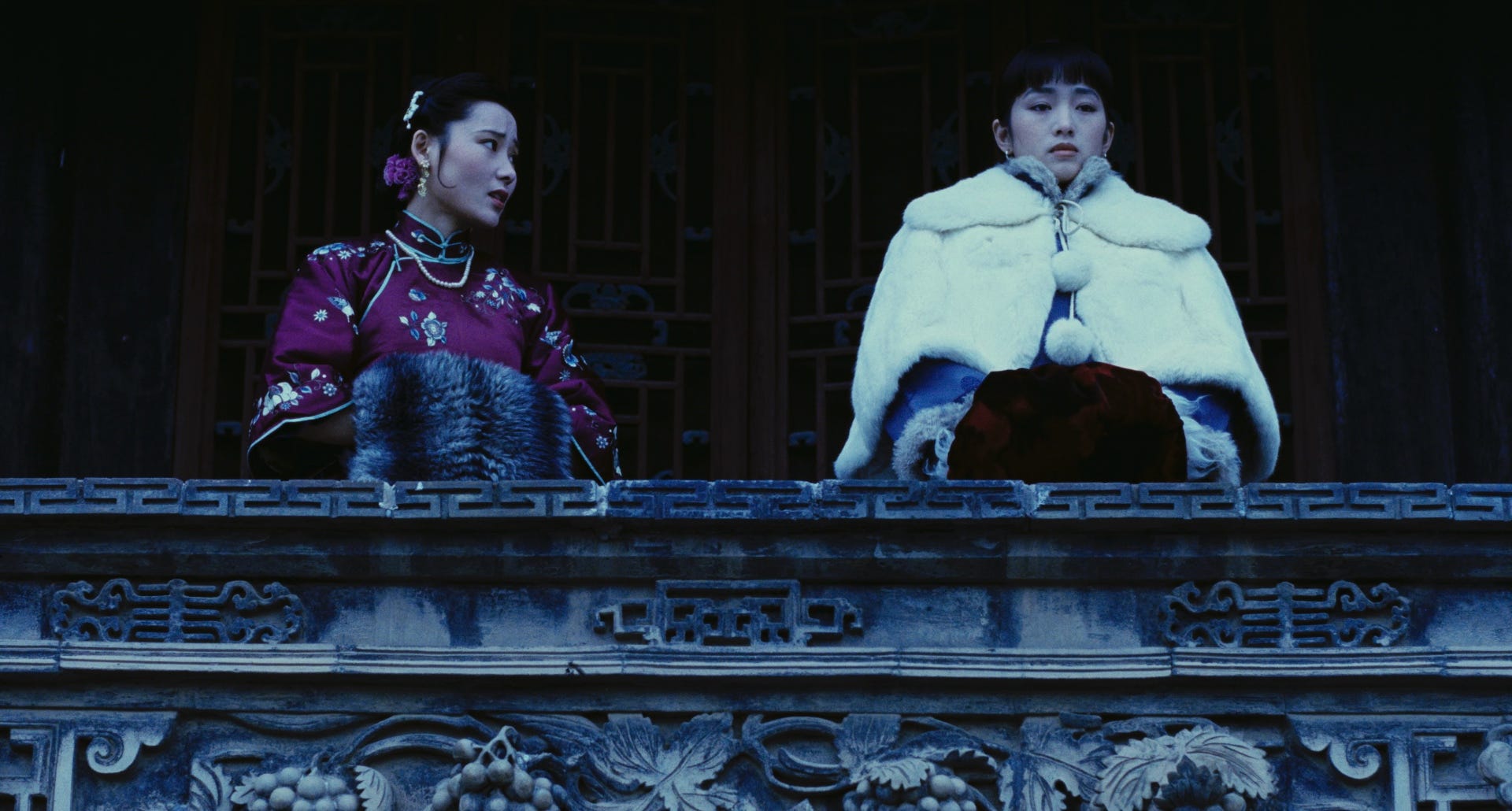
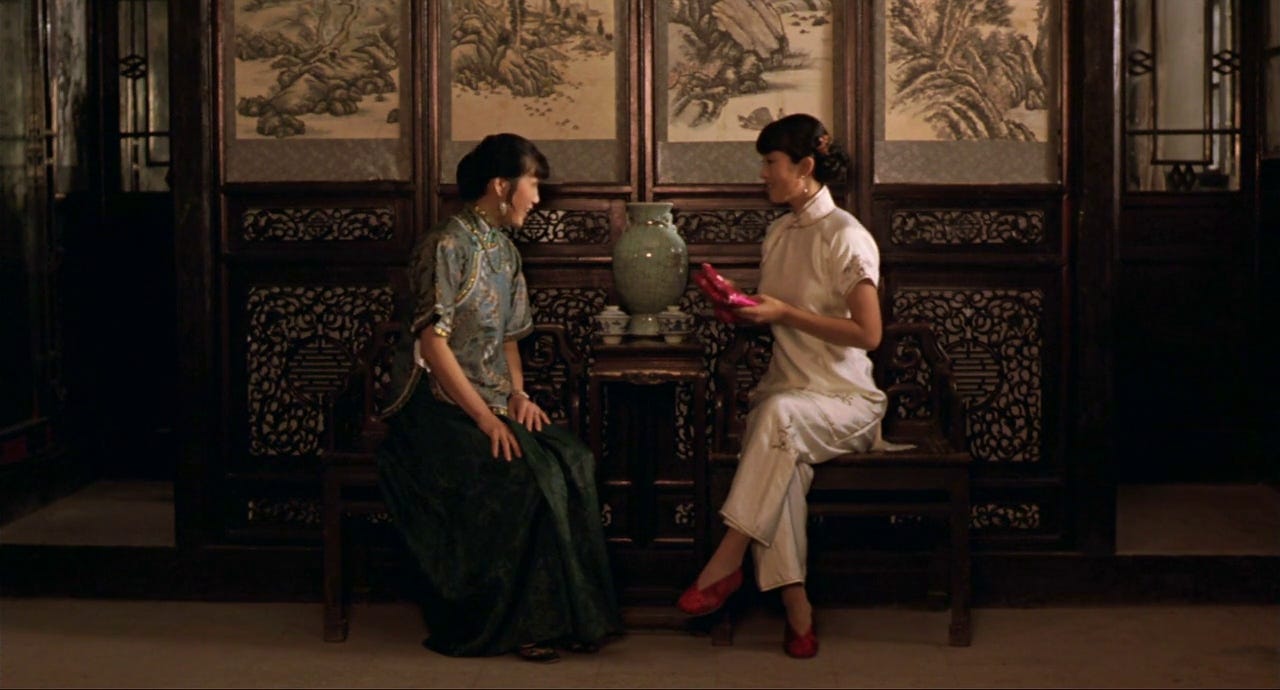
We later learn that Zhuoyun is actually the one actively plotting against Songlian in the shadows, while Meishan becomes more frank and sympathetic to Songlian.
Meishan and Zhuoyun appear in absolute contrast in each other as a means to illustrate how performances of femininity can both conceal and reveal a woman’s intentions: Zhuoyun’s outward obedience and propriety disguise her cruelty, while Meishan’s theatricality and open defiance ultimately make her the more sincere of the two. Their contrast reveals how the household rewards women who perform conformity, while expressions of individuality are viewed as threatening and dangerous. There’s an exchange between Songlian and Meishan I love that sums this up well.
Songlian: “I’ve come to listen to the third sister sing. You sing so well.”
Meishan: “Good or bad it’s all playacting. If you play well, you fool the others. If you play badly, you can only fool yourself. If you can’t fool yourself, you can fool the ghosts.”
Songlian: “People breathe, ghosts cannot. That’s the only difference. People are ghosts, and ghosts are people.”
While Raise the Red Lantern is famous for its composition, its sound design is equally astounding. While Zhang’s compositions continually reinforce confinement, the film’s sound design offers a means of transcending boundaries. The characters’ voices and music travel throughout the compound, often reaching beyond what the camera itself allows us to see. The sound of the shaking foot massage rattles is one of the most recurring sounds throughout the film, heard throughout the courtyard every night to marking the victory of the day’s chosen wife. What is a source of pleasure for one woman becomes a reminder of exclusion for the others.
When Songlian arrives at the compound, she brings a flute that belonged to her late father, one of the few possessions connecting her to her previous life. She later hears Feipu, the master’s eldest son (closer to her age of 18) playing flute and follows the music to find him. The two immediately share an undeniable spark that ultimately doesn’t amount to anything notable in the film, but the yearning flute plays to mark the eldest son’s arrival in every scene thereafter, symbolizing an alternative version of Songlian’s life. When Chen discovers Songlian’s flute, he has it burned, mistakenly believing it to be a gift from a male university acquaintance.
Meishan sings opera on the compound’s rooftops throughout the film, both to signal her mood and to attract Master Chen. In the third act of the film, Meishan is executed for having an affair that Songlian drunkenly reveals to Zhuoyun who then outs Meishan to the rest of the household. After her execution, Songlian lights the lanterns of the third wife’s house and plays a recording of Meishan singing on a gramophone, terrifying the servants who believe they are hearing Meishan’s ghost. Overcome with the guilt and shock of Meishan’s death, Songlian goes mad, walking back and forth in the courtyard to a ghostly version of Meishan’s singing. Her physical presence extinguished, her voice continues to haunt the house.
When we see Songlian in the film’s epilogue, she is wearing the schoolgirl clothes she wore when she first arrived. Though she is still physically trapped there, it’s as though she’s retreated into the version of herself that existed before coming to the compound. The film ends as it begins, with the arrival of another woman, this time as the fifth wife. Meishan is dead, Songlian has lost her sanity, and yet the household continues almost entirely unchanged. Another cycle begins, with the same symmetrical courtyards, the same rituals, the same hierarchy of wives competing for the master’s favor.
There’s something particularly haunting about the permanence of the architecture against the impermanence of the women who inhabit it. Each arrives with her own personality, desires, and history, only to be reduced to yet another replaceable wife. By the end, the compound’s perfect symmetry takes on a new meaning: an order so rigid and self-sustaining that even the destruction of its inhabitants cannot disturb it.